- SalesforceChaCha
- Posts
- 💃 Bridging Apex and Flow 🕺
💃 Bridging Apex and Flow 🕺
One system, not two

Salesforce ChaCha
December 23, 2025 • Estimated Reading Time: 2 minutes
Good morning, Salesforce Nerds! For some reason in the ecosystem, Salesforce automation is often framed as a choice. ↔️
That framing is comfortable, familiar, and wrong. ❌
In modern orgs, Apex and Flow execute inside the same transaction, governed by the same limits, rollbacks, and data rules.
Treating them as separate systems leads to duplicated logic, brittle error handling, and tests that miss real-world failure modes. 😱
A unified Apex + Flow strategy flips the model.
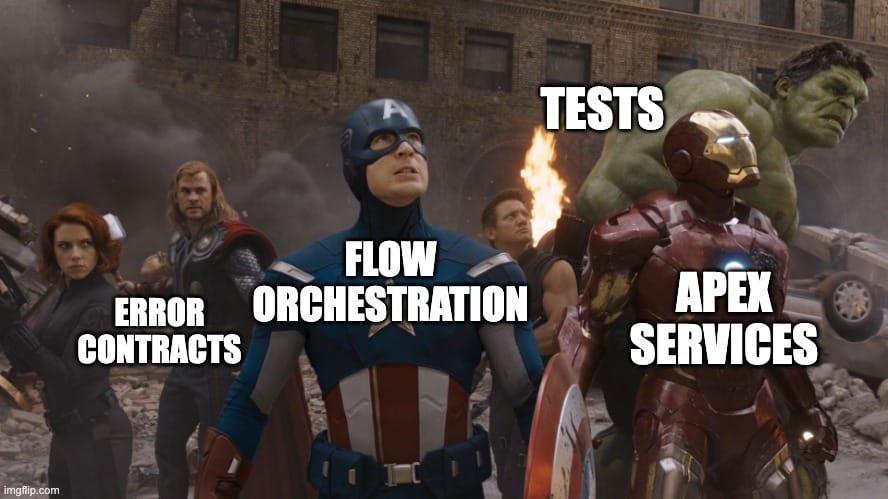
Flow orchestrates. Apex executes. Errors are intentional. Tests are layered. 🔥
The result is automation that scales without collapsing under its own weight.
TABLE OF CONTENTS
💃 Bridging Apex and Flow 🕺
CLEANER LANES, CLEANER SYSTEMS
ONE AUTOMATION ENGINE
When Flow invokes Apex, nothing “crosses over” into a different system. ⛔️
Both run in the same transaction. That means shared governor limits, shared rollbacks, and shared consequences if something goes wrong.
This is the first mental shift. 🧠
Apex and Flow are not glued together. They are composed together.
A record-triggered Flow evaluates conditions, sequences steps, and invokes Apex. 👈️
Apex may perform complex validation, DML, or integration logic, then return control to Flow.
Everything happens before commit.
Once you design with this reality in mind, automation decisions get simpler. ☺️
You stop duplicating logic and start designing seams that hold under load.
CHEEKY HEADER
ORCHESTRATE VS EXECUTE
The most reliable Apex + Flow designs have strict responsibility boundaries. 📦️
Flow orchestrates. Apex executes.
Flow decides when something happens. It reacts to data changes, branches on conditions, and routes outcomes.
Apex handles how things happen. Complex logic, bulk-safe processing, cross-object rules, and integration behavior belong in Apex.
Invocable Apex methods act as contracts. 📜
Flow supplies context and intent. Apex performs the work and returns a structured result. 💪
Conceptually:
@InvocableMethod
public static List<Result> execute(List<Input> inputs) {
  // validate, compute, return outcomes
}
Flow does not know how the logic works. Apex does not know why it was called.
That separation keeps both sides readable, reusable, and testable. 💯
FAILURES WITH INTENT
STRUCTURED ERROR CONTRACTS
Most Apex + Flow failures come from unstructured error handling. 🫠
Either Apex throws exceptions Flow cannot reason about, or Flow absorbs errors without context.
A hybrid model works best. 🧬
Expected business failures are returned as structured results.
Apex communicates known failure states explicitly. Flow branches on them declaratively. ✨
Unexpected failures throw exceptions. These surface through Flow fault paths and signal that something truly broke.
Think in two lanes. Known problems are handled. Unknown problems are escalated. 🛣️
This gives you predictable failures, observable behavior, and automation that fails loudly without failing mysteriously.
ISOLATE LOGIC, VALIDATE WIRING
UNIFIED TESTING STRATEGY
Unified automation requires layered testing. 🧪
Apex-first testing is the foundation. Business rules, validation, and edge cases should be tested directly in Apex.
These tests are fast, deterministic, and expressive. 💨
Flow testing validates orchestration.
It ensures the right Apex methods are called under the right conditions and that fault paths behave correctly. ✅
You are testing wiring, not computation.
Declarative Flow tests continue to mature, but they complement Apex tests rather than replace them. 🤝
Apex remains the sharpest tool for proving logic at scale.
Together, these layers cover the system without duplicating effort.
SCALE WITHOUT FEAR
BUILD ONE SYSTEM
When Apex and Flow are treated as one automation system, everything improves. 📈
Flows stay readable because they orchestrate instead of compute. Apex stays reusable because logic lives in services instead of triggers.
Errors become intentional. Tests become meaningful. 💥
Most importantly, the system evolves cleanly.
New flows reuse existing services. New entry points honor the same contracts. Refactors happen in one place. ❤️
That is how enterprise automation survives real growth on Salesforce.
SOUL FOOD
Today’s Principle
"Simple can be harder than complex. You must work hard to clean your thinking and make it simple."
and now....Salesforce Memes
What did you think about today's newsletter? |