- SalesforceChaCha
- Posts
- 💃 Pay For Salesforce Consultants, or Use Your In-House?🕺
💃 Pay For Salesforce Consultants, or Use Your In-House?🕺
Hire the Chef, Keep the Line Cooks

Salesforce ChaCha
April 09, 2026 • Estimated Reading Time: 3 minutes
Good morning, Salesforce Nerd! Every mid-market CEO asks the same question at some point-
"Do I really need to pay a Salesforce consulting partner, or can my in-house team handle it?"
🤔
The thing is, that’s the wrong question…
The right question, the one that actually saves you money, sounds like this-
"Am I asking my line cooks to design the menu?"
Because that's what you're doing. And the math on that mistake is ugly 🫣
DREAM TEAM
Salesforce In-House AND Consultant 🤝
On paper, in-house looks like a steal 😃. A solid Salesforce consultant in the U.S. earns roughly $93K to $127K a year, which pencils out to about $45 to $61 an hour before benefits, according to Salary.com and ZipRecruiter. Load that with benefits, taxes, PTO, laptops, and the birthday cake fund, and you're at maybe $70 an hour all-in.
Meanwhile a senior consultant comes in around $250 an hour.
So in-house wins. Case closed. Right?
Not quite 🙅.
Consider this - an in-house admin and developer have full-time jobs supporting the day-to-day Salesforce support, maintenance and enhancements.
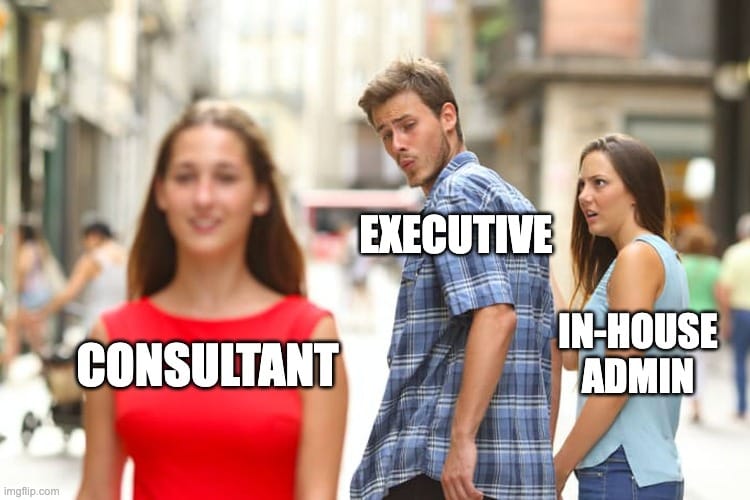
And the executive team has decided replacing the current Zendesk solution with Service Cloud will unify customer data and improve customer experience significantly 💪.
The admin and developer have Sales Cloud experience, but not have Service Cloud. They’ve never setup a ticket system before.
They are talented and can certainly figure it out, but where is the space to learn, understand, and implement with insights when they already have full plates with their Sales Cloud responsibilities?
A consultant brings knowledge, skills and experience in the exact domain you need it for a relatively quick and clean implementation 🥷.
Your in-house team is folded into the project but not consumed by it 😌. They can manage their current responsibilities and be well-informed when Service Cloud is passed to them for support and maintenance 😃.
THE MENU vs THE LINE
Two Different Jobs, Two Different Salesforce Professionals
Back to the kitchen. Every restaurant has two distinct functions, and confusing them is how Michelin stars become complaints on Yelp 🤬.
The chef 🧑🍳 designs the menu. They pick the concept, source the suppliers, engineer the margins, decides what goes on the plate and what the plate costs you. This happens a few times a year, with high stakes and permanent consequences.
The line cooks 👷♂️ run service. Every night. Same stations, same tickets, same dishes. They keep the kitchen humming, they catch mistakes, they know which burner runs hot 🔥.
Your Salesforce partner is the chef. Your in-house admin is the line. Ask the line cook to redesign the menu during Saturday dinner rush and you get exactly what you deserve, a burned kitchen and a walkout 😔.
AN INVESTMENT
Is a Salesforce Consulting Partner Worth the Cost?
Short version- ✅ YES, for the implementation. ❌ NO, for the day-to-day operation.
A partner earns their premium in exactly three scenarios 👇
⚙️ New implementation - designing the menu. Pattern recognition from 50 prior builds is worth $250 an hour all day long 🙌.
🔀 Complex integrations or a net-new cloud (Revenue Cloud, Data Cloud, Agentforce, Marketing Cloud, Experience Cloud). You are adding a station to the kitchen. Line cooks have never done this one.
🏥 Recovery work after a bad build, aka rescue. The kitchen is on fire. You need someone who has put out this exact fire before, and you need them tonight.
For everything else, which is to say 80% of your Salesforce life, in-house for sure-
👍 User support
👍 Small enhancements
👍 Data hygiene
👍 Report building
👍 Permission sets
👍 New-hire onboarding
That work is cheaper, faster, and better when the person doing it eats at your cafeteria.
IDC projects the Salesforce ecosystem will generate $2.02T in business revenue and 11.6M jobs between 2022 and 2028.
Translation 👉 there is plenty of talent on both sides of the fence, and the strategic question is which talent, when.
FINAL THOUGHTS
Takeaway
If you’re deciding between bringing on professional help or leveraging your existing team, consider these questions 👇
❓ Is this a menu decision (architecture, new cloud, redesign) or a service decision (tickets, tweaks, support)?
❓ If this build goes sideways, what's the revenue cost of a 90-day delay?
❓ Does my in-house team have pattern recognition from 3+ similar projects, or am I buying their first rodeo?
❓ Am I embedding my admin into the partner's build, or am I paying twice to learn the same lessons?
You can take these questions and answers straight to the steering committee for a lively discussion 😃!
SOUL FOOD
Today’s Principle
"If you think hiring a professional is expensive, wait until you hire an amateur." - Paul “Red” Adair
and now....Your Salesforce Memes


What did you think about today's newsletter? |