- SalesforceChaCha
- Posts
- 💃 The Quick Win Tax Bill 🕺
💃 The Quick Win Tax Bill 🕺
Nobody budgets for this

Salesforce ChaCha
April 16, 2026 • Estimated Reading Time: 3 minutes
Good morning, Salesforce Nerds!
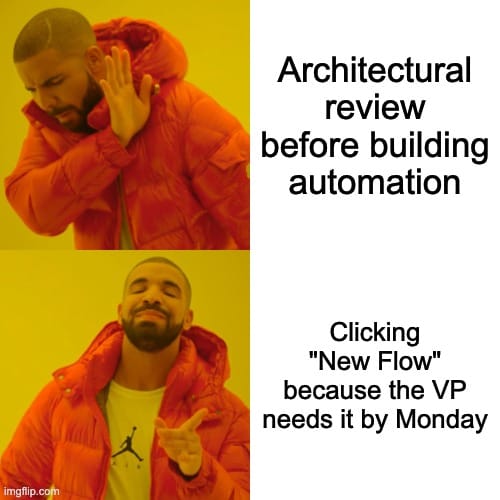
Every Salesforce org has one: the automation that somebody built on a Friday afternoon because the VP of Sales needed it by Monday.
It took two hours. It shipped without a review. It worked … kind of … and the team moved on.
Now, eighteen months later, that two-hour Flow is quietly tripping over three other Flows, two Apex triggers, and a Process Builder that nobody remembers deploying. The record save takes four seconds. Nobody knows why. 😬
This is the quick win tax. And at enterprise scale, the bill is enormous.

TABLE OF CONTENTS
💃 The Quick Win Tax Bill 🕺
INCENTIVES SHAPE EVERYTHING HERE
SPEED IS THE WRONG METRIC
The quick win problem is not a technical failure. It's an incentive failure. 💯
Teams that deliver automation fast get praised. Teams that push back to design something properly get labeled as blockers.
Quarterly OKRs reward feature count. Backlogs reward story point velocity. Nobody's OKR reads: "Maintain automation architecture integrity through Q3." 🏆
So builders do what the system rewards. They ship. They click. They close the ticket.
The irony is that this pattern makes perfect sense to every individual involved. The admin who built the Flow was responding to real pressure. The manager who approved it was trying to hit a deadline. The executive who needed it by Monday had a legitimate business need.
Every decision, viewed in isolation, was reasonable. 🤔
Together, they produce an org that no single person fully understands. And that nobody has the mandate to fix.
OUT OF SIGHT, OUT OF BUDGET
DEBT YOU CAN’T SEE IS DEBT YOU WON’T PAY
Technical debt in Salesforce is uniquely invisible. 🫥
Unlike a slow-loading website or a crashing app, automation debt hides in execution paths that nobody monitors.
A single record save in a mature org can silently trigger a Workflow Rule from 2019, two record-triggered Flows from 2022, an after-save Flow added last quarter, and an Apex trigger that predates your current team. Each piece was justified when it was built. Together, they create execution behavior that no one designed and no one can fully predict. 🕵️
Performance debt doesn't show up as a single line item. It appears as distributed cost. Transactions slow by fractions of a second. Users adapt. Expectations quietly reset downward.
By the time leadership escalates it as a problem, the cost has already been absorbed hundreds of thousands of times across thousands of users.
Governor limits make this worse. Salesforce enforces hard caps on SOQL queries, DML operations, heap size, and CPU time per transaction.
One poorly designed Flow that loops unnecessarily, or an unindexed query buried in an Apex trigger, doesn't just slow one user — it can cause cascading limit exceptions under bulk load.
That's not a corner case in enterprise environments. That's Tuesday during month-end close. 🔥
LATER IS A MYTH, ACTUALLY
WHY “WE’LL FIX IT LATER” NEVER WORKS
The most dangerous phrase in enterprise Salesforce is "we'll clean it up in the next sprint." 💔
It almost never happens. Not because teams are lazy, but because the incentive structure never changes. The next sprint has its own tickets. The backlog has its own pressures.
Remediation work is real, it's expensive, and it delivers nothing the business can see.
Technical debt is usually placed in the "important but not urgent" quadrant, with many organizations failing to prioritize remediation projects because they don't deliver immediate commercial results and are typically pushed by technical teams, not business stakeholders. 🥹
This is the compounding problem. Debt left in place becomes the foundation for new work built on top of it.
The next admin doesn't know the bad pattern exists. They just know what's already there. They build on it. Their successor builds on that.
Five years later, you have an org where nobody dares touch the Opportunity object because the last person who tried broke CPQ for a week. 😅
IT’S THE ACTUAL SPEED
GOVERNANCE ISN’T A SLOW DOWN
The fix is not technical. It's structural. 🏗️
Mature organizations treat Salesforce as a product, not a service desk. That means automation goes through a design review before anyone opens Flow Builder. Naming conventions exist and are enforced. An Architecture Review Board has teeth — and the authority to say "not yet" without that decision being escalated away.
The audit is the starting point. 🔍
Run Salesforce Optimizer. Map every automation on your Opportunity, Account, and Lead objects. Count the execution paths on a single record save.
Most teams are shocked by what they find. That shock is useful. It's the moment organizational will aligns with technical reality.
From there, the work is incremental. Consolidate redundant Flows. Establish a one-trigger-per-object pattern with a proper trigger framework. Document what runs and why. 🔄
Build a remediation backlog and treat it like any other product work — prioritized, resourced, and tracked.
WHAT YOU BUILD SHOWS WHAT YOU VALUE
THE ORG REFLECTS CULTURE
Your Salesforce org is a mirror. 🪞
Every ungoverned Flow, every undocumented automation, every quick win that shipped without review. All of it reflects the decisions and incentives that produced it.
The good news is that incentives can change. 💡
If your teams are rewarded only for speed, automation debt will accumulate. If delivery includes an expectation of architectural integrity, it slows down the right things and speeds up everything else.
The organizations that invest in governance today aren't moving slower — they're the ones who can still say yes to new business requirements in three years without a six-month refactor first.
Audit your automation layer. Map what's there. Build the governance structure before the next quick win lands in production.
The bill is already due. The question is whether you pay it now, on your terms, or later when the interest has compounded past the point of control. ⏳
SOUL FOOD
Today’s Principle
"Left unchecked, technical debt will ensure that the only work that gets done is unplanned work."
and now....Salesforce Memes


What did you think about today's newsletter? |